Good bookkeeping gives business owners more than organised records. It provides the financial visibility needed to manage cash
Bookkeeping & Financial Management
 By Oswago & Associates
September 09, 2026
By Oswago & Associates
September 09, 2026
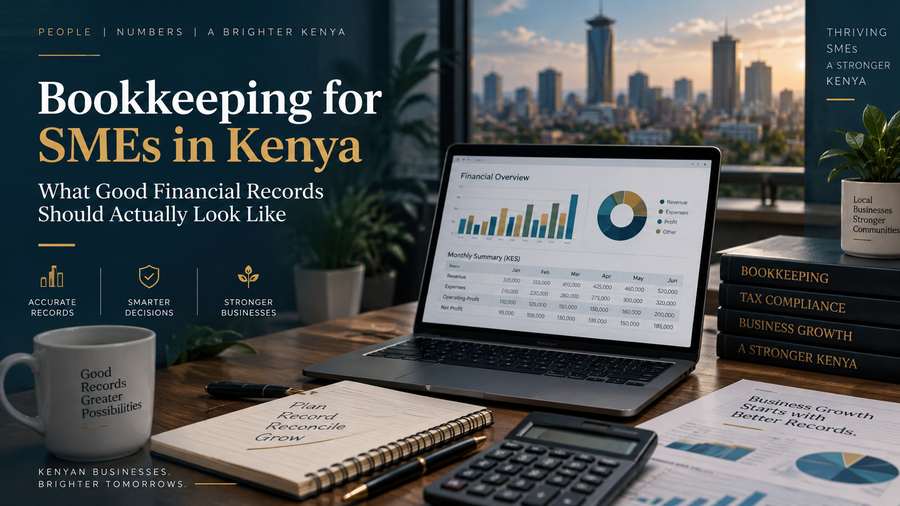
Bookkeeping for SMEs in Kenya: What Good Financial Records Should Actually Look Like
By Oswago & Associates
September 09, 2026
Running a growing business involves hundreds of financial decisions.
You are paying suppliers, collecting from customers, processing M-Pesa transactions, paying employees, buying stock, settling taxes and trying to understand whether the business is actually making money.
Yet many businesses only look closely at their accounting records when a tax deadline approaches, the bank requests financial information or cash begins to run short.
Good bookkeeping should work differently.
For SMEs in Kenya, bookkeeping should provide an accurate and continuously updated picture of what is happening financially in the business. It should help management understand where money is coming from, where it is going, what the business owes, what customers owe the business and whether operations are generating sustainable profit.
What Is Bookkeeping?
Bookkeeping is the systematic recording and organisation of a business's financial transactions.
It includes recording sales, purchases, operating expenses, customer payments, supplier payments, payroll transactions, bank movements, M-Pesa transactions and other financial activities.
But recording transactions is only the beginning.
A useful bookkeeping system should also ensure that the information recorded agrees with supporting documents and actual balances.
That means regularly reconciling bank accounts, M-Pesa accounts, customer balances, supplier balances and other key accounts.
When this is done consistently, management can rely on the accounting information when making decisions.
Why Bookkeeping Matters More as a Business Grows
A small business may initially operate with relatively few transactions.
The owner can often remember who has paid, which supplier needs money and roughly how much the business has spent.
As the business grows, this becomes increasingly difficult.
More customers create more receivables. More suppliers create more obligations. Employees introduce payroll and statutory requirements. Additional payment channels create more transactions that require reconciliation.
Without a structured accounting process, the owner may still see money moving through the bank account without having a clear understanding of the financial position behind those movements.
A healthy bank balance does not automatically mean the business is profitable.
Part of that money may already be committed to suppliers, payroll, taxes, loan repayments or customer deposits.
Good bookkeeping separates these issues and gives management a more complete picture.
What Good Bookkeeping Should Show You
At any reasonable point during the month, a properly maintained accounting system should help you answer questions such as:
- How much revenue has the business earned?
- Which customers still owe us money?
- Which suppliers have not yet been paid?
- What are our major operating expenses?
- Are expenses increasing faster than revenue?
- What taxes and statutory obligations are approaching?
- How much cash is actually available after upcoming commitments?
- Is the business profitable?
- Which products, projects, branches or activities are performing well?
If answering these questions requires searching through WhatsApp messages, bank statements, notebooks and old spreadsheets, the bookkeeping process probably needs improvement.
1. Your Bank and M-Pesa Accounts Should Be Reconciled
One of the most important bookkeeping controls is reconciliation.
A reconciliation compares the transactions recorded in the accounting system with the actual transactions appearing on the bank or M-Pesa statement.
This helps identify missing transactions, duplicate entries, unrecorded bank charges, customer payments that have not been allocated correctly and other differences.
For businesses processing frequent transactions, reconciliations should not be left until year-end.
They should form part of the regular accounting routine.
The objective is simple: the accounting system should agree with reality.
2. Customer Balances Should Be Clear
If your business sells on credit, the accounting system should show exactly which customers owe money and how long those balances have been outstanding.
An accounts receivable report can help management distinguish between recent invoices and long-overdue balances.
This matters because revenue shown in the accounts does not necessarily mean cash has been collected.
A business can report strong sales while experiencing serious cash-flow pressure because customers are taking too long to pay.
Regularly reviewing customer balances helps management follow up collections earlier.
3. Supplier Obligations Should Be Tracked
The same principle applies to suppliers.
Good bookkeeping should show:
- invoices received,
- payments made,
- outstanding supplier balances,
- upcoming obligations.
This helps the business plan payments instead of discovering large outstanding balances unexpectedly.
Supplier information is especially important when preparing short-term cash-flow forecasts.
4. Expenses Should Be Categorised Properly
Recording every payment simply as an "expense" provides very little useful information.
Expenses should be organised into meaningful categories such as rent, salaries, transport, utilities, professional fees, marketing, repairs, software subscriptions and other operating costs relevant to the business.
Proper categorisation allows management to identify where money is being spent and which expenses are changing over time.
For project-based businesses, costs may need to be allocated further to individual projects or jobs.
For hospitality businesses, management may want visibility over food, beverage, payroll and operating costs.
For property managers, expenses may need to be tracked by property or landlord.
Good accounting should reflect how the business actually operates.
5. Payroll Should Connect With the Accounting Records
Payroll should not sit completely outside the accounting system.
Salary costs, employee deductions, employer obligations and payroll payments should be properly reflected in the financial records.
This improves both reporting and compliance.
Management can then see the actual cost of employees and how payroll affects overall operating expenses and cash flow.
6. Supporting Documents Should Be Organised
Reliable accounting requires supporting documentation.
Invoices, receipts, supplier statements, contracts, payroll records, bank statements and other relevant documents should be maintained systematically.
Digital record-keeping can make this considerably easier.
Good documentation supports reconciliations, tax compliance, management review and any future financial verification that may be required.
7. Management Should Receive Regular Financial Reports
Bookkeeping becomes much more valuable when it produces useful reports.
At minimum, growing businesses should regularly review:
Profit and Loss Statement — shows revenue, expenses and profitability over a particular period.
Balance Sheet — shows assets, liabilities and the financial position of the business.
Cash Flow information — helps management understand how cash is being generated and used.
Accounts Receivable — shows outstanding customer balances.
Accounts Payable — shows outstanding supplier obligations.
Depending on the business, additional reports may include project profitability, departmental performance, inventory reports or property-level statements.
The objective is not to produce reports simply because accounting software can generate them.
The objective is to give management information that supports decisions.
Common Signs Your Bookkeeping Needs Attention
Businesses often need accounting clean-up before they need more advanced financial analysis.
Warning signs include regularly unreconciled bank accounts, unexplained differences between accounting balances and actual cash, duplicate transactions, missing expenses, customer balances that cannot be confirmed, supplier balances that do not agree with statements and financial reports that management does not trust.
Another major warning sign is when business owners cannot obtain reliable monthly financial information without manually reconstructing transactions.
If records must constantly be rebuilt before a report can be prepared, the underlying accounting process needs improvement.
Bookkeeping Should Support Tax Compliance
Accurate accounting records also make tax compliance easier.
Tax returns and statutory filings should be supported by reliable underlying records.
When bookkeeping is maintained consistently throughout the year, businesses are less likely to find themselves reconstructing months of transactions immediately before a filing deadline.
It also becomes easier to review whether transactions have been classified correctly and whether supporting documentation is available.
Good compliance therefore begins with good accounting records.
How Often Should an SME Update Its Books?
For most growing businesses, waiting until the end of the year is far too late.
Transaction-heavy businesses may require daily or weekly updates, while smaller businesses may operate effectively with a structured weekly or monthly process.
What matters is consistency.
Bank reconciliations, customer balances, supplier balances and major obligations should be reviewed frequently enough for management to act on the information.
The accounting records should remain close enough to current operations that the reports still have decision-making value.
Accounting Software Helps, but It Is Not the Entire Solution
Platforms such as QuickBooks, Xero, Zoho Books and other accounting systems can make bookkeeping significantly more efficient.
However, accounting software does not automatically create accurate financial records.
The system still requires:
- an appropriate chart of accounts,
- correct transaction categorisation,
- regular reconciliation,
- proper customer and supplier records,
- accurate opening balances,
- consistent accounting processes.
A poorly configured accounting system can produce professional-looking reports containing unreliable information.
The quality of the process remains more important than the software itself.
What Good Bookkeeping Ultimately Gives a Business Owner
The biggest benefit of good bookkeeping is not simply clean records.
It is financial clarity.
A business owner should be able to understand the company's position without guessing.
You should know what has been earned, what has been spent, what is owed, what needs to be paid and whether the business is generating the financial results you expect.
That information makes it easier to control costs, manage cash flow, plan growth and identify problems before they become serious.
Accounting then moves from being an administrative obligation to becoming part of how the business is managed.
Need Better Control of Your Accounting Records?
At Oswago & Associates, we help SMEs and growing businesses in Kenya organise their bookkeeping, reconcile accounts, improve financial records and prepare reliable management reports.
Whether your business needs ongoing bookkeeping support or help cleaning up existing records, we can help establish an accounting process that gives you clearer financial visibility.